
Smart sleep planning — bedtime, wake time, kids routines, naps, sleep debt & more
1. When do you naturally feel most alert?
2. How easily do you fall asleep?
3. Ideal time to start work/study?
- Pick a tab above — Bedtime, Wake-Up, Kids Bedtime, Nap, Sleep Debt, Caffeine, Chronotype, or Fajr.
- Fill in the fields for that tab (time, age group, or your recent sleep hours).
- Press the blue button to calculate — your results appear right below it.
- Where shown, RECOMMENDED means the cycle option closest to the selected age group’s planning target.
- Switch tabs anytime to try a different calculator — your other results stay saved.
Free Sleep Calculator: Bedtime, Wake-Up Time & Sleep Cycles by Age
By the NexusEase Tools Team · Last updated July 2026 · 16 min read
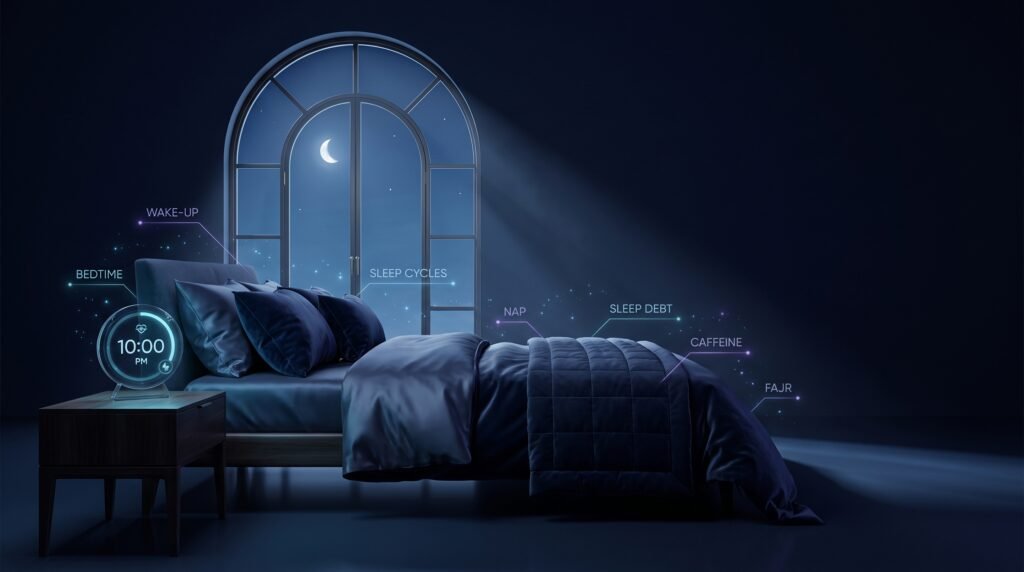
Getting enough sleep is important, but sleep duration is only one part of a healthy sleep schedule. Your age, bedtime, wake-up time, sleep consistency, naps, caffeine intake, circadian rhythm, and the amount of time you need to fall asleep can all influence how rested you feel.
The NexusEase Sleep Master Calculator is an all-in-one sleep planning tool designed to help you calculate your bedtime, wake-up time, naps, sleep debt, caffeine cutoff, chronotype, and sleep schedule around Fajr prayer.
Instead of manually counting hours, you can enter your preferred sleep or wake-up time and receive practical timing suggestions based on your age and an estimated 90-minute sleep-cycle model.
The calculator includes seven dedicated modes:
- Bedtime Calculator
- Wake-Up Calculator
- Nap Calculator
- Sleep Debt Calculator
- Caffeine Cutoff Calculator
- Chronotype Quiz
- Fajr Sleep Planner
Quick Answer: A sleep calculator works backward from your required wake-up time—or forward from your bedtime—to estimate a practical sleep schedule. The NexusEase Sleep Master Calculator also uses approximately 90-minute sleep cycles as a planning model. However, real sleep cycles vary between people and throughout the night, so cycle calculations should be treated as useful estimates rather than exact biological measurements.
How to Use the Sleep Master Calculator
Using the calculator takes only a few seconds:
- Select Bedtime, Wake-Up, Nap, Sleep Debt, Caffeine, Chronotype, or Fajr.
- Enter the requested information, such as your bedtime, wake-up time, age group, or recent sleep duration.
- Press the calculation button.
- Review the suggested results.
- Look for the recommended option where available.
- Switch between calculator modes to explore other parts of your sleep schedule.
This allows you to manage several sleep-related calculations from one page instead of using separate tools.
What Is a Sleep Calculator?
A sleep calculator estimates suitable bedtime or wake-up options based on your schedule.
Suppose you need to wake up at 7:00 AM.
You could simply subtract eight hours and choose 11:00 PM as your bedtime. However, this doesn't account for the time you need to fall asleep or provide alternative timing options based on estimated sleep cycles.
A bedtime calculation can be represented as:
Target Wake-Up Time − Required Sleep − Sleep Latency = Suggested Bedtime
A wake-up calculation reverses the process:
Bedtime + Sleep Latency + Required Sleep = Suggested Wake-Up Time
Rather than pretending that one exact bedtime is perfect for everyone, NexusEase provides several possible options that you can compare with your age-based sleep needs and daily schedule.
The Science of Sleep Cycles: NREM, REM & Sleep Inertia
Sleep isn't one continuous state.
Throughout the night, your brain progresses through different stages of Non-Rapid Eye Movement (NREM) and Rapid Eye Movement (REM) sleep.
These stages repeat in cycles, but the duration and composition of each cycle can vary throughout the night.
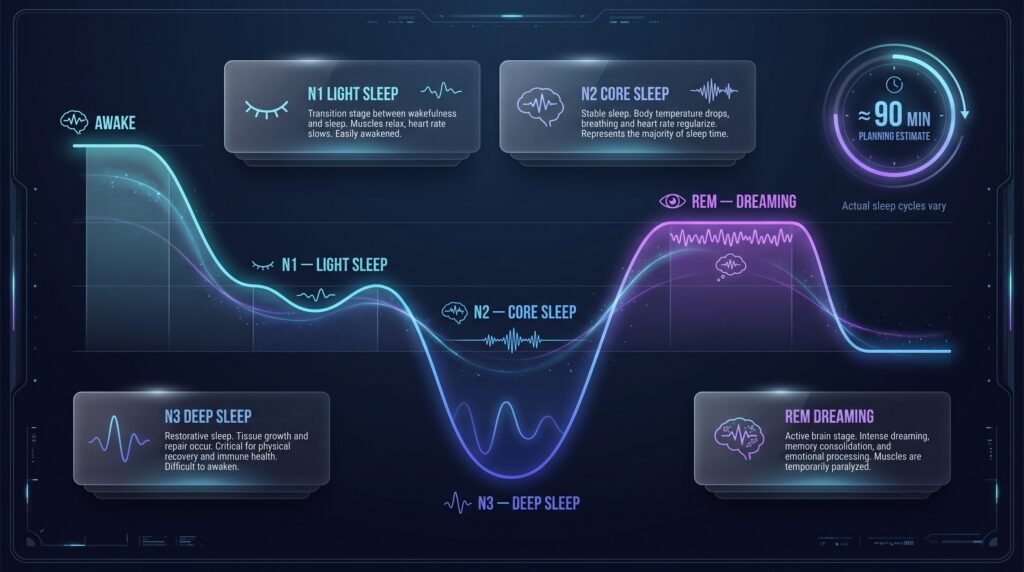
Sleep Cycle Stages Infographic — N1 → N2 → N3 → REM, with a note explaining that cycle duration varies between individuals.
Stage N1: Transition Into Sleep
N1 is the transition between wakefulness and sleep.
Muscle activity begins to decrease, awareness of your surroundings fades, and you can usually still be awakened relatively easily.
Stage N2: Light/Core Sleep
During N2, heart rate and breathing slow, body temperature decreases, and characteristic patterns of brain activity associated with sleep appear.
People typically spend a substantial portion of the night in N2 sleep.
Stage N3: Deep Sleep
N3 is commonly known as deep sleep or slow-wave sleep.
This stage is associated with physical restoration and is generally more difficult to wake from than lighter sleep stages.
Being awakened from deeper sleep can contribute to stronger sleep inertia in some situations.
REM Sleep
REM sleep is associated with high brain activity, vivid dreaming, memory processing, learning, and emotional processing.
REM periods generally become longer later in the night.
Are Sleep Cycles Exactly 90 Minutes?
No.
Although sleep is frequently described in 90-minute cycles, 90 minutes is an approximation rather than an exact biological timer.
Real sleep-cycle duration varies between individuals and can also change from one cycle to another during the same night.
The NexusEase Sleep Master Calculator therefore uses 90 minutes as a simplified planning model.
It cannot determine whether you're actually in N1, N2, N3, or REM sleep at a particular minute because the calculator does not measure brain activity.
Use 90-minute cycle calculations as sleep scheduling estimates, not guaranteed sleep-stage boundaries.
What Is Sleep Inertia?
Sleep inertia is the temporary period of grogginess, reduced alertness, and slower thinking that can occur immediately after waking.
Waking from deeper sleep can contribute to stronger sleep inertia.
However, sleep inertia isn't determined only by whether you woke at a theoretical cycle boundary.
Other factors can include:
- Sleep deprivation
- Fragmented sleep
- Circadian timing
- Irregular sleep schedules
- Medications
- Alcohol
- Overall sleep quality
This leads to one important rule:
Getting enough total sleep should take priority over perfectly matching a theoretical 90-minute cycle.
Don't intentionally reduce adequate sleep simply because a shorter sleep duration divides neatly into 90-minute blocks.
Why Sleep Latency Matters
Getting into bed isn't the same as falling asleep.
The period between attempting to sleep and actually falling asleep is called sleep latency.
For example:
Get into bed: 10:30 PM
Fall asleep: 10:45 PM
Wake up: 6:45 AM
Your actual sleep period begins closer to 10:45 PM.
That's why a useful bedtime calculator should account for the amount of time you normally need to fall asleep instead of assuming that sleep begins instantly.
Recommended Sleep Duration by Age
Sleep requirements change substantially throughout life.
A sleep calculator by age is therefore more useful than giving every user the same eight-hour target.
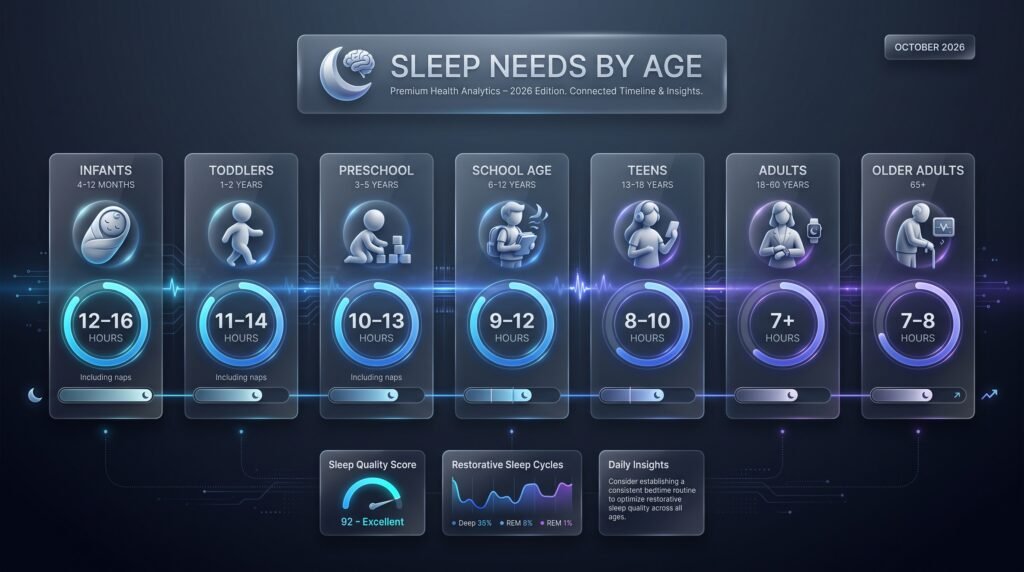
Recommended Sleep Duration by Age Infographic — Infant → Toddler → Preschool → School-Age → Teen → Adult → Older Adult.
| Age Group | Age | General Recommended Sleep |
|---|---|---|
| Infants | 4–12 months | 12–16 hours, including naps |
| Toddlers | 1–2 years | 11–14 hours, including naps |
| Preschoolers | 3–5 years | 10–13 hours, including naps |
| School-Age Children | 6–12 years | 9–12 hours |
| Teenagers | 13–18 years | 8–10 hours |
| Adults | 18–60 years | 7 or more hours |
| Adults | 61–64 years | 7–9 hours |
| Older Adults | 65+ years | 7–8 hours |
These are general population recommendations rather than personalized medical prescriptions.
Individual requirements can vary depending on health, activity, sleep quality, pregnancy, medications, medical conditions, and other factors.
Kids Bedtime Calculator: Sleep Schedules by Age
One of the most common questions parents ask is:
“What time should my child go to bed?”
There isn't one bedtime that works for every child.
A more useful formula is:
Required Wake-Up Time − Required Sleep − Time to Fall Asleep = Target Bedtime
For younger children, daytime naps also need to be considered.
A 3-year-old taking a 90-minute afternoon nap may therefore need a different nighttime schedule from another 3-year-old who no longer naps.
Bedtime Routine for 2-Year-Olds
Toddlers aged 1–2 generally need around 11–14 hours of total sleep per 24 hours, including naps.
Many 2-year-olds still take one daytime nap.
If a child wakes around 7:00 AM, bedtime may commonly fall somewhere around 7:00 PM to 8:00 PM, depending on nap duration and individual sleep requirements.
Example 2-Year-Old Bedtime Routine
6:30 PM: Quiet play
6:45 PM: Bath and pajamas
7:00 PM: Brush teeth
7:10 PM: Story or another calm activity
7:30 PM: Lights out
The exact clock time matters less than providing sufficient total sleep and maintaining a predictable routine.
Bedtime Routines for 3-Year-Olds
A 3-year-old sleep schedule can become more complicated because daytime napping often begins to change around the preschool years.
Children aged 3–5 generally need around 10–13 hours of sleep per 24 hours, including naps.
What Time Should a 3-Year-Old Go to Bed?
If a 3-year-old needs to wake around 7:00 AM, bedtime may commonly fall somewhere around 7:00 PM to 8:00 PM, depending on the child's individual sleep requirement and daytime naps.
Example 3-Year-Old Sleep Schedule
7:00 AM: Wake up
1:00 PM: Nap or quiet time if needed
6:30 PM: Begin bedtime routine
7:00–8:00 PM: Bedtime window
If the child stops napping, bedtime may need to move earlier so they can continue receiving enough total sleep.
A simple bedtime routine might be:
Dinner → Quiet Play → Bath → Pajamas → Brush Teeth → Story → Lights Out
Consistency is generally more useful than creating an overly complicated bedtime routine.
Bedtime Routines for 4-Year-Olds
Four-year-olds generally remain within the 10–13 hours of sleep per 24 hours preschool range.
At this age, naps can make a major difference.
Some children still nap regularly, while others no longer nap at all.
What Time Should a 4-Year-Old Go to Bed?
Suppose your 4-year-old wakes at 7:00 AM.
Approximate nighttime targets could look like:
- 10 hours: asleep around 9:00 PM
- 11 hours: asleep around 8:00 PM
- 12 hours: asleep around 7:00 PM
Daytime naps must also be included when considering total daily sleep.
Bedtime for a 4-Year-Old With No Nap
If a 4-year-old no longer takes daytime naps and wakes around 7:00 AM, a practical bedtime may fall around 6:45 PM to 7:30 PM when targeting approximately 11–12 hours of nighttime sleep.
This is a useful starting range rather than a rigid requirement.
Individual sleep needs still vary.
Bedtime Routines for 5-Year-Olds
How much sleep does a 5-year-old need?
Five-year-olds generally need approximately 10–13 hours of total sleep per 24 hours.
What Time Should a 5-Year-Old Go to Bed?
For a child who needs to wake around 6:30 AM for school, a practical target may be to have them asleep around 7:00 PM to 7:45 PM when aiming for roughly 10.5–11.5 hours of nighttime sleep.
Remember that the child needs to be asleep around the target time.
If they normally need 15–20 minutes to fall asleep, lights-out should occur earlier.
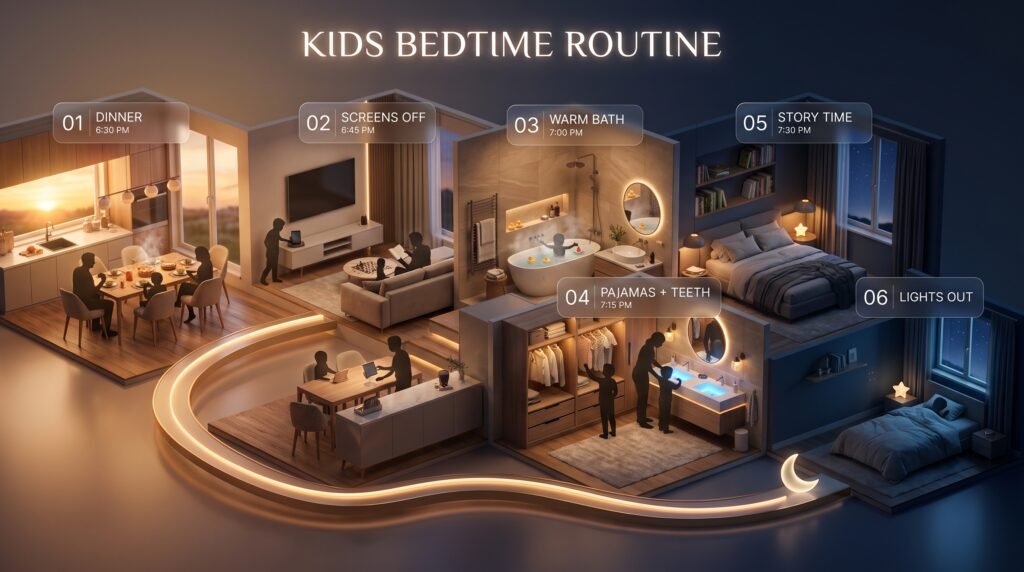
Kids Bedtime Routine Timeline — Dinner → Screens Off → Bath → Pajamas → Story → Lights Out.
What Time Should 6 to 8-Year-Olds Go to Bed?
Children aged 6–12 generally need approximately 9–12 hours of sleep.
For a child waking at 7:00 AM, the calculation might look like this:
| Desired Sleep | Approximate Time Asleep |
|---|---|
| 9 hours | 10:00 PM |
| 10 hours | 9:00 PM |
| 11 hours | 8:00 PM |
| 12 hours | 7:00 PM |
This is why there isn't one universal answer to questions such as:
“What time should a 6-year-old go to bed?”
or:
“What time should a 7-year-old go to bed?”
Work backward from the required morning wake-up time and choose a bedtime that provides enough sleep.
What Time Should 9 to 12-Year-Olds Go to Bed?
Older school-age children still need considerably more sleep than many adults.
For example, a 10-year-old who:
- needs approximately 10 hours of sleep
- and wakes at 7:00 AM
would need to be asleep around 9:00 PM.
Is 9 PM Too Late for a 10-Year-Old?
Not necessarily.
A child sleeping from 9:00 PM to 7:00 AM has a ten-hour sleep opportunity.
But a child sleeping from 9:00 PM to 5:30 AM has only eight and a half hours.
So instead of asking only:
“Is 9 PM too late?”
Ask:
“Does this bedtime provide enough sleep before my child has to wake up?”
Teen Sleep: How Much Sleep Do Teenagers Need?
Teenagers aged 13–18 generally need around 8–10 hours of sleep per 24 hours.
Teen sleep timing can shift later during adolescence while school schedules may still require very early wake-up times.
That can create a difficult combination:
Later sleep tendency + early school alarm
If a teenager needs to wake at 6:30 AM, approximate sleep targets are:
- 8 hours: asleep around 10:30 PM
- 9 hours: asleep around 9:30 PM
- 10 hours: asleep around 8:30 PM
Homework, gaming, social media, extracurricular activities, and late-night screen use can make these schedules harder to maintain.
Bedtime Calculator: What Time Should I Go to Bed?
Use the Bedtime Calculator when you already know what time you need to wake up.
The basic calculation is:
Wake-Up Time − Required Sleep − Sleep Latency = Suggested Bedtime
For example, if you need to wake at 6:30 AM, the calculator works backward and provides several possible bedtime options.
Which Bedtime Should You Choose?
First identify options that provide enough total sleep for your age and needs.
Then use the estimated cycle timing as an additional way to compare suitable options.
Don't choose a six-hour sleep opportunity over an eight-hour option merely because six hours divides neatly into four theoretical 90-minute cycles.
Wake-Up Calculator: What Time Should I Wake Up?
The Wake-Up Calculator performs the calculation in reverse.
Enter your planned bedtime and the calculator estimates potential wake-up times based on the sleep-cycle model.
This can be particularly useful when your morning schedule is flexible.
The suggested times remain estimates.
The calculator cannot know which sleep stage your brain will actually be in when the alarm rings.
Nap Calculator: 20, 60 or 90 Minutes?
Different nap lengths can serve different purposes.
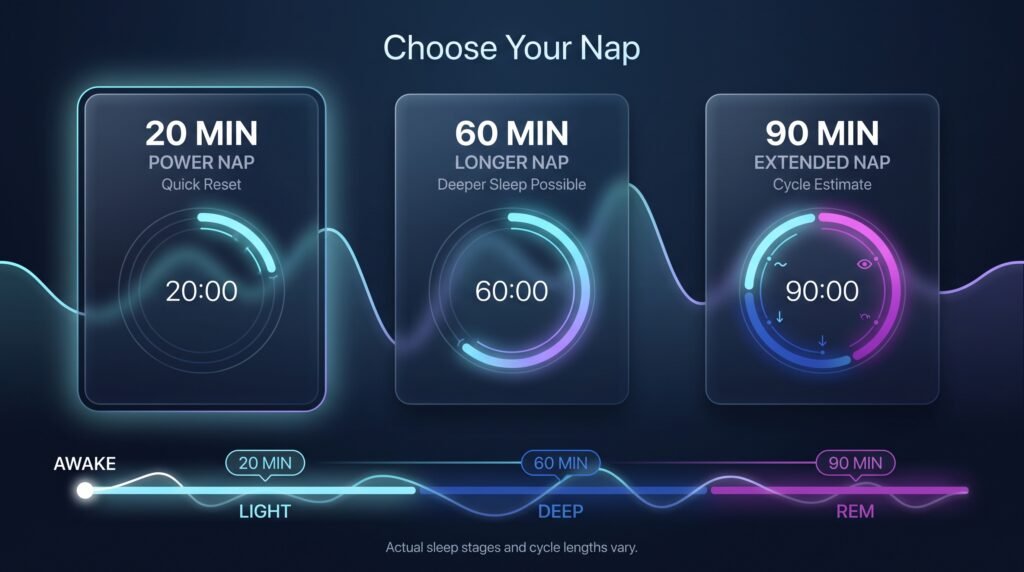
Nap Duration Comparison Infographic — 20-Minute Power Nap vs 60-Minute Nap vs 90-Minute Full-Cycle Estimate.
20-Minute Power Nap
A short 10–20 minute nap can provide a quick period of rest while reducing the opportunity to enter deeper sleep.
This makes short naps popular when someone wants a daytime refresh without spending a large part of the day asleep.
60-Minute Nap
A 60-minute nap provides substantially more sleep opportunity and may include deeper sleep.
Some people therefore experience temporary grogginess immediately after waking.
90-Minute Nap
A 90-minute nap approximates the commonly used average duration of one complete sleep cycle.
It provides more sleep opportunity than a short power nap.
However, real sleep cycles aren't always exactly 90 minutes, and longer naps taken late in the day can interfere with nighttime sleep for some people.
Sleep Debt Calculator: How Much Sleep Are You Missing?
Sleep debt describes accumulated insufficient sleep compared with the amount of sleep you need.
Suppose your target is eight hours per night:
| Day | Actual Sleep | Shortfall |
|---|---|---|
| Monday | 6.5 hours | 1.5 hours |
| Tuesday | 7 hours | 1 hour |
| Wednesday | 6 hours | 2 hours |
| Thursday | 7 hours | 1 hour |
| Friday | 6 hours | 2 hours |
By the end of several short nights, the deficit can become substantial.
The NexusEase Sleep Debt Calculator allows you to enter recent sleep hours and estimate your accumulated shortfall.
Can You Catch Up on Sleep Debt?
Additional sleep can help following periods of insufficient sleep.
However, repeatedly sleeping too little during the week and relying entirely on extremely long weekend sleep isn't an ideal long-term strategy.
A more sustainable approach is to increase your normal sleep opportunity and reduce the repeated deficit.
Caffeine Cutoff Calculator: When Should You Stop Drinking Coffee?
Caffeine can remain active in your body for hours after consumption.
Its biological half-life varies considerably between individuals and can be affected by genetics, medications, pregnancy, smoking status, and other physiological factors.
A practical starting point for many people is to stop caffeine approximately 6–8 hours before bedtime.
The NexusEase Caffeine Cutoff Calculator helps you compare your planned bedtime with your last caffeine intake.
Caffeine sources can include:
- Coffee
- Tea
- Energy drinks
- Cola
- Pre-workout products
- Chocolate
- Other caffeinated foods and beverages
If you're sensitive to caffeine or continue having difficulty sleeping, try moving your cutoff earlier.
Chronotype Quiz: Are You a Lion, Bear, Wolf or Dolphin?

Some people naturally feel most alert early in the morning.
Others reach their peak later in the day.
A chronotype describes tendencies in preferred sleep and activity timing.
The NexusEase Chronotype Quiz considers factors such as:
- When you naturally feel most alert
- How easily and when you fall asleep
- When you prefer to work or study
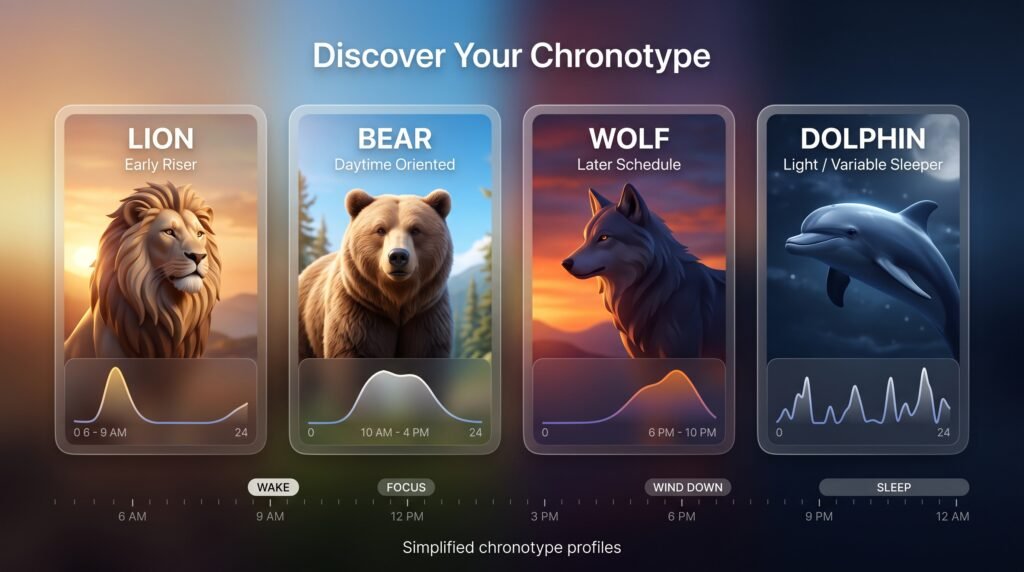
Chronotype Comparison Infographic — Lion, Bear, Wolf and Dolphin with example daily activity timelines.
The popular Lion, Bear, Wolf, and Dolphin categories should be treated as simplified, engaging descriptions rather than clinical diagnoses.
Your actual sleep timing is influenced by many factors beyond a quiz result.
Circadian Rhythm: Understanding Your Internal Body Clock
Your circadian rhythm is an internal timing system that operates on roughly a 24-hour cycle.
Light is one of the strongest environmental signals affecting this system.
Bright daytime light supports wakefulness, while the transition toward darkness helps signal that nighttime is approaching.
Your sleep schedule, activity, meals, and light exposure can all interact with your circadian rhythm.
Morning Light
Natural light after waking can help reinforce the transition into daytime.
Evening Light
Bright environmental lighting and stimulating screen use late at night can make winding down more difficult for some people.
Reducing unnecessary bright light as bedtime approaches can therefore be useful.
How to Build a Better Sleep Schedule: Practical Steps
A sleep calculator can suggest a schedule.
Your habits determine whether that schedule becomes sustainable.
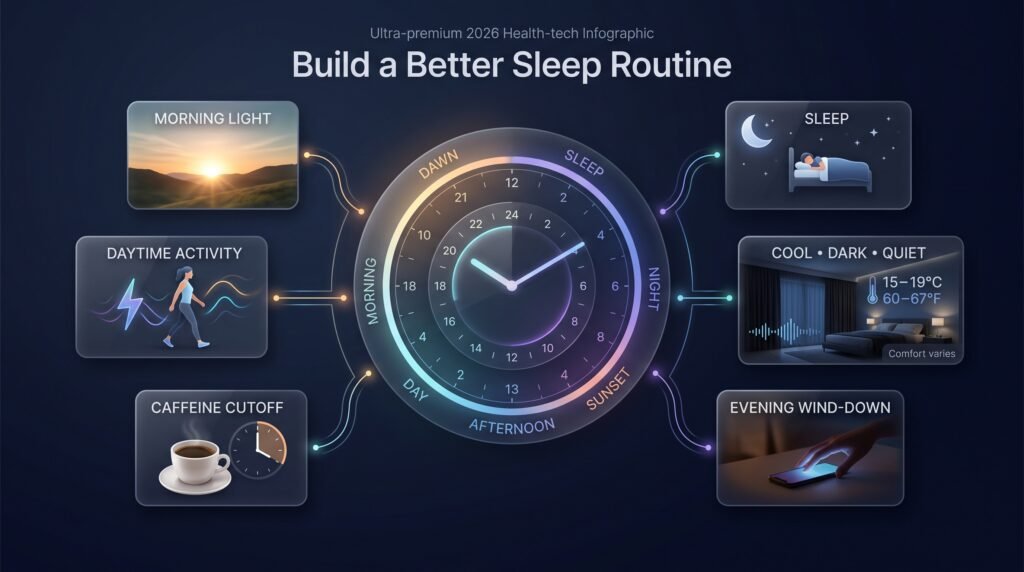
Healthy Sleep Routine Checklist — Morning Light → Daytime Activity → Caffeine Cutoff → Wind-Down → Cool/Dark Bedroom → Sleep.
1. Keep a Consistent Sleep Window
Try to wake up and go to bed at reasonably similar times each day, including weekends where practical.
A stable wake-up time can help anchor your overall sleep routine.
You don't need to follow the exact same minute every day.
The goal is to avoid dramatic and frequent schedule swings.
2. Dim the Lights Before Bed
During the final 30–60 minutes before bedtime, begin reducing bright light and highly stimulating activities.
Consider:
- Lowering room lighting
- Reducing unnecessary screen brightness
- Pausing intense gaming
- Finishing demanding work
- Switching to calmer activities
This creates a clearer transition between daytime activity and sleep.
3. Keep Your Bedroom Comfortable, Cool & Dark
Your sleep environment can influence how easily and comfortably you sleep.
- Temperature: Keep your bedroom slightly cool. A commonly suggested range is around 15°C to 19°C (60°F–67°F), although individual comfort varies.
- Darkness: Use blackout curtains, blinds, or an eye mask if artificial street lighting enters the room.
- Noise: Consider white noise, a fan, or earplugs if environmental noise regularly disturbs your sleep.
- Comfort: Choose bedding and pillows that help you remain comfortable throughout the night.
Don't treat one exact temperature as a medical requirement. The best bedroom temperature is ultimately one that is comfortably cool for you.
4. Establish a Consistent Wind-Down Habit
Create a relaxing 20–30 minute pre-sleep routine.
For example:
- Read a physical book
- Do gentle stretching
- Listen to calm audio
- Prepare clothes or tasks for tomorrow
- Practice slow breathing
- Take a comfortable shower
Repeating a calm routine can help create a consistent behavioral signal that active parts of the day are ending and sleep is approaching.
5. Watch Your Evening Meals
Large, heavy, spicy, or uncomfortable meals immediately before lying down can make sleep less comfortable for some people.
When practical, leave approximately 2–3 hours between a large evening meal and bedtime.
6. Manage Caffeine Timing
If you have difficulty falling asleep, experiment with moving your final caffeine intake earlier.
The Caffeine Cutoff Calculator can provide a starting point, but your individual response matters.
7. Exercise Regularly
Regular physical activity supports overall health and may support healthy sleep.
If intense late-night exercise makes you feel highly alert, consider moving demanding workouts earlier in the day.
8. Prioritize Enough Sleep Before Optimizing Cycles
This is the most important rule:
Adequate total sleep first. Estimated cycle optimization second.
A theoretically perfect cycle calculation cannot compensate for chronic sleep deprivation.
Sleep for Athletes & Physical Recovery
Sleep is important for athletes because training requires both physical and cognitive recovery.
Adequate sleep supports processes involved in:
- Physical recovery
- Motor learning
- Reaction time
- Decision-making
- Training readiness
- General health
Athletes shouldn't automatically assume they need one exact universal number of hours.
Age, training intensity, competition schedules, travel, and individual recovery demands all matter.
Strategic short naps may also be useful when nighttime sleep has temporarily been restricted.
Sleep Tips for Shift Workers
Shift workers face a unique challenge because required sleep may occur during a period when their body would normally expect wakefulness.
Helpful strategies can include:
- Darkening the bedroom
- Blocking environmental noise
- Keeping the bedroom comfortably cool
- Maintaining as much schedule consistency as practical
- Managing light exposure around work and sleep
- Protecting enough total sleep time
Rotating schedules can be particularly challenging because the required sleep window repeatedly changes.
Persistent insomnia or severe sleepiness related to shift work may warrant individualized medical or occupational-health guidance.
Parents & Fragmented Sleep
Parents of babies and young children often can't maintain one uninterrupted nighttime sleep period.
Repeated awakenings can make sleep less restorative even when total hours appear reasonable.
When circumstances allow, parents can consider:
- Sharing nighttime responsibilities
- Protecting longer uninterrupted sleep blocks
- Taking short naps strategically
- Prioritizing adequate total sleep
- Avoiding unnecessary late-night activities when sleep opportunities are limited
A sleep calculator can't convince a toddler that 3:00 AM isn't playtime—but it can help you plan the sleep opportunities you can control.
Sleep for Adults 65+
Sleep patterns can change with age.
Older adults may experience:
- Earlier sleep and wake tendencies
- Lighter sleep
- More nighttime awakenings
- Changes in daytime napping
- More fragmented sleep
Adults aged 65+ generally need around 7–8 hours of sleep.
Persistent sleep difficulties shouldn't automatically be dismissed as a normal consequence of aging.
Pain, medications, sleep-disordered breathing, and other medical factors may contribute and deserve appropriate evaluation.
Fajr Sleep Planner: Planning Sleep Around Dawn Prayer

For Muslims, Fajr can create a unique sleep-planning challenge.
Depending on the season and location, Fajr may occur much earlier than a person's usual morning wake-up time.
The NexusEase Fajr Sleep Planner allows you to enter the time you need to wake for Fajr and works backward using the calculator's approximate 90-minute sleep-cycle model to suggest possible bedtimes.
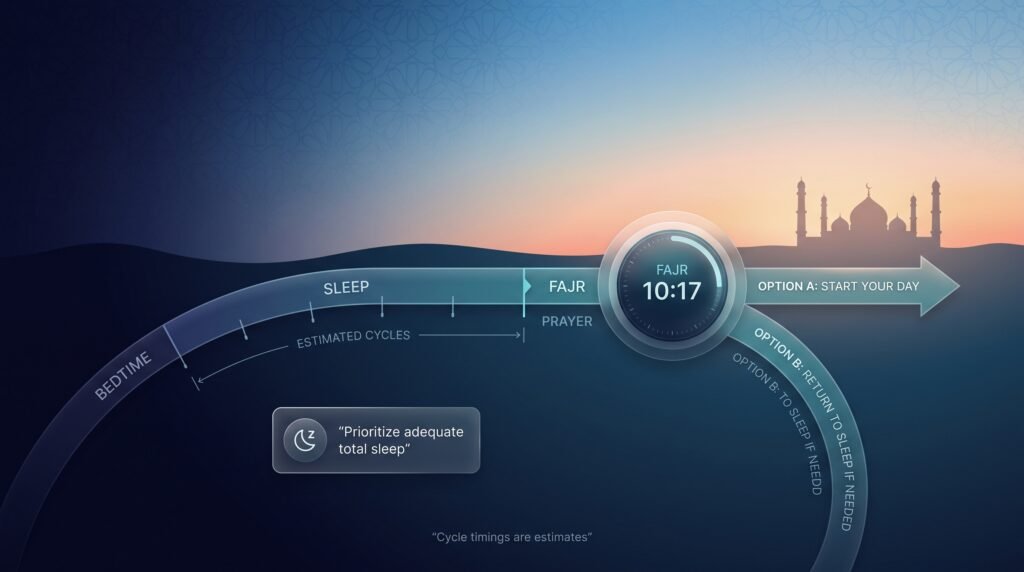
Fajr Sleep Planning Timeline — Evening/Isha → Bedtime → Sleep → Fajr → Prayer → Stay Awake OR Return to Sleep.
What Is the Best Bedtime for Fajr?
Start with your local Fajr time and work backward far enough to provide adequate total sleep.
For example, if you need to wake around 5:00 AM, going to sleep at midnight provides only about five hours before prayer.
An earlier bedtime may therefore be necessary.
The calculator provides cycle-based scheduling suggestions, but sufficient total sleep should remain the priority.
Can I Sleep Again After Fajr?
Yes, if your schedule allows and you still need additional sleep.
Some people stay awake after Fajr and begin their day.
Others return to sleep after prayer.
Sleeping after Fajr isn't inherently unhealthy. What matters more is whether your complete 24-hour sleep pattern provides sufficient rest and works sustainably with your responsibilities.
The Fajr Sleep Planner can therefore help you decide whether to:
Sleep earlier → wake for Fajr → start the day
or:
Sleep → wake for Fajr → pray → return to sleep
Ramadan Sleep Strategy
Ramadan can significantly change normal sleep schedules because of Iftar, Isha, Taraweeh, Suhoor, Fajr, work, school, and fasting.
For some people, one uninterrupted nighttime sleep block becomes difficult.
A practical option may be split sleep.
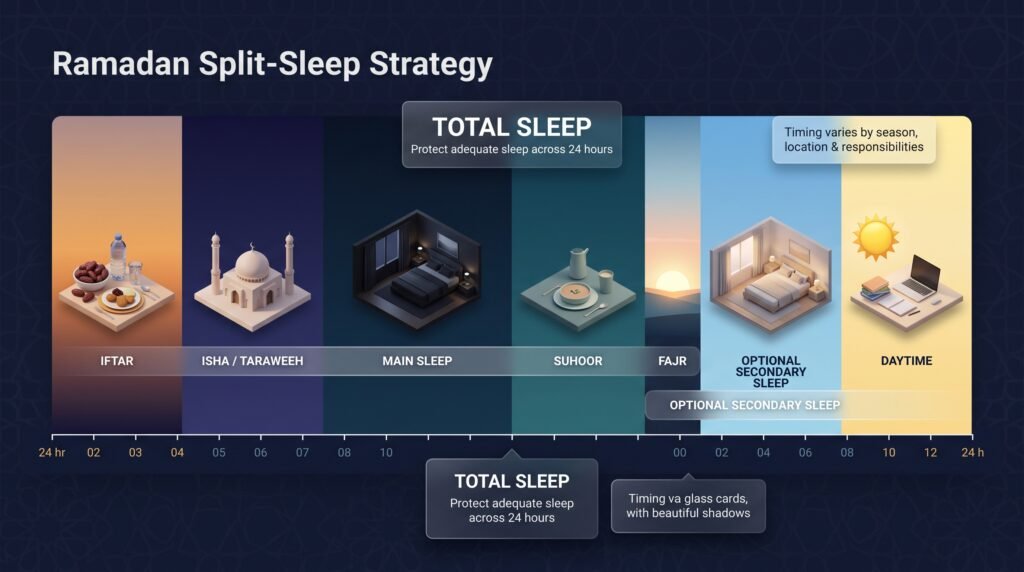
Ramadan Sleep Schedule — Iftar → Isha/Taraweeh → Main Sleep → Suhoor → Fajr → Secondary Sleep → Day.
An example could be:
Main sleep: After Isha/Taraweeh
Wake: For Suhoor and Fajr
Additional sleep: After Fajr if work or school timing allows
The goal isn't to force everyone into one identical Ramadan sleep schedule.
Instead, protect adequate total sleep across the 24-hour period and maintain as much consistency as circumstances permit.
Common Sleep Scheduling Mistakes
1. Prioritizing Sleep Cycles Over Total Sleep
Don't intentionally choose six hours simply because it equals four theoretical 90-minute cycles if your body needs more sleep.
2. Treating 90 Minutes as an Exact Biological Rule
Your brain doesn't restart a stopwatch every 90 minutes.
Cycle timing is an estimate.
3. Ignoring Sleep Latency
If you usually need 20–30 minutes to fall asleep, include that time when planning your bedtime.
4. Consuming Caffeine Too Late
Late caffeine can affect sleep even when you still manage to fall asleep.
5. Taking Long Naps Late in the Day
Long or late naps may reduce nighttime sleepiness in some people.
6. Using the Same Sleep Target for Every Age
A 4-year-old, 15-year-old, and 40-year-old don't have identical sleep requirements.
7. Ignoring Persistent Sleep Problems
A calculator isn't a substitute for medical evaluation when symptoms are persistent or severe.
Sleep Calculator vs. Manually Calculating Your Sleep
You can calculate basic sleep duration manually:
11:00 PM → 7:00 AM = 8 hours
But sleep planning becomes more complicated when you want to account for:
- Age
- Bedtime
- Wake-up time
- Sleep latency
- Estimated sleep cycles
- Naps
- Sleep debt
- Caffeine timing
- Chronotype
- Fajr
An all-in-one sleep schedule calculator makes it easier to adjust one input and immediately compare different options.
Frequently Asked Questions (FAQs)
What time should a 3-year-old go to bed?
Children aged 3–5 generally need 10–13 hours of sleep per 24 hours, including naps. If a 3-year-old wakes around 7:00 AM, bedtime may commonly fall around 7:00–8:00 PM depending on nap duration and individual sleep needs.
What time should a 4-year-old go to bed with no nap?
If a 4-year-old no longer takes daytime naps and wakes up around 7:00 AM, a practical bedtime window is approximately 6:45 PM to 7:30 PM when targeting around 11–12 hours of nighttime sleep.
Individual sleep requirements vary, so treat this as a starting range rather than a rigid rule.
What time should a 5-year-old go to bed on a school night?
For a 6:30 AM school wake-up, a 5-year-old may need to be asleep around 7:00 PM to 7:45 PM to provide approximately 10.75–11.5 hours of nighttime sleep.
Preschool children generally need 10–13 total hours per 24 hours, including any naps.
How much sleep does a 5-year-old need?
A 5-year-old generally needs approximately 10–13 hours of total sleep per 24 hours, including naps where applicable.
What time should a 6-year-old go to bed?
Children aged 6–12 generally need approximately 9–12 hours of sleep. Work backward from the child's required wake-up time to determine a bedtime that provides enough sleep.
What time should a 10-year-old go to bed?
If a 10-year-old needs around ten hours of sleep and wakes at 7:00 AM, they should be asleep around 9:00 PM.
A child who needs more sleep should have an earlier bedtime.
How many hours did I sleep?
Calculate the difference between the time you actually fell asleep and the time you woke up, subtracting significant periods spent awake during the night.
For example, 11:00 PM to 7:00 AM represents an eight-hour sleep window.
Why do I wake up feeling exhausted after 8 hours of sleep?
Sleep inertia can contribute to morning grogginess, particularly when waking from deeper sleep such as Stage N3.
However, waking from deep sleep isn't the only possible explanation.
Fragmented sleep, inconsistent schedules, stress, caffeine, alcohol, poor sleep quality, circadian timing, medical conditions, and other factors can also contribute.
An estimated 90-minute sleep cycle calculator can help you experiment with different sleep and wake times, but it cannot determine your actual sleep stage.
Are sleep cycles exactly 90 minutes?
No.
90 minutes is an approximation frequently used by sleep calculators.
Actual sleep-cycle duration varies between individuals and throughout the night.
How many sleep cycles should I get?
There is no universal required number of 90-minute cycles.
Prioritize the recommended total amount of sleep for your age and individual needs rather than targeting a fixed number of theoretical cycles.
Is 6 hours of sleep enough?
Six hours is below general sleep recommendations for most adults and is also below recommended ranges for children and teenagers.
Regularly sleeping only six hours may therefore be insufficient for many people.
Is 7 hours of sleep enough?
Seven hours meets the general minimum recommendation for many adults, although individual sleep requirements vary.
Children and teenagers generally require more.
Is 8 hours of sleep enough?
Eight hours falls within a healthy recommended range for many adults and teenagers.
Younger children generally require more total sleep.
What is the best nap length?
A 10–20 minute nap can provide a short period of rest with less opportunity to enter deeper sleep.
Longer 60- or 90-minute naps provide more sleep opportunity but can cause temporary grogginess or affect nighttime sleep for some people.
What is sleep debt?
Sleep debt describes accumulated insufficient sleep compared with the amount you need.
For example, if you need eight hours but repeatedly sleep six hours, the shortfall accumulates over several nights.
Can you catch up on sleep debt?
Additional sleep can help following periods of insufficient sleep.
However, chronic sleep restriction is better addressed by consistently providing enough sleep opportunity rather than relying entirely on occasional long sleep-ins.
When is the ideal cutoff time for caffeine before bed?
Because caffeine can remain active for hours, a useful starting point is to stop consuming coffee, tea, energy drinks, and other significant caffeine sources approximately 6–8 hours before your target bedtime.
Caffeine metabolism varies considerably, so caffeine-sensitive individuals may benefit from an earlier cutoff.
Can a sleep calculator tell when I'm in REM or deep sleep?
No.
A calculator uses mathematical timing estimates and does not measure brain activity.
It therefore cannot know whether you're actually experiencing REM, N2, N3, or another sleep stage.
Can I use the Sleep Calculator for Fajr?
Yes.
The NexusEase Sleep Master Calculator includes a dedicated Fajr Sleep Planner that works backward from your Fajr wake-up time and provides possible bedtime options using the tool's sleep-cycle model.
Is sleeping after Fajr unhealthy?
Sleeping after Fajr isn't inherently unhealthy.
Whether it works well depends on your total sleep duration, sleep quality, schedule, and individual circumstances.
If Fajr interrupts your main sleep period and your responsibilities allow it, returning to sleep can form part of a split-sleep schedule.
Related NexusEase Tools
Explore other useful NexusEase calculators and utilities:
- Word Counter & Analyzer
- BMI Calculator
- Engagement Rate Calculator
- Calorie Calculator
- Zakat Calculator
Internal links should be added only where they genuinely help the reader continue their task.
Medical & Educational Disclaimer
The NexusEase Sleep Master Calculator and this accompanying guide are intended solely for general scheduling, lifestyle planning, informational, and educational purposes.
They do not constitute clinical medical advice, formal diagnosis, or medical treatment.
The calculator uses simplified mathematical estimates, including an approximately 90-minute sleep-cycle model. It does not directly measure brain activity, REM sleep, deep sleep, circadian phase, or clinical sleep quality.
Individual sleep requirements vary according to age, personal health, medications, genetics, physiology, lifestyle, pregnancy, environmental conditions, and other factors.
The NexusEase Sleep Master Calculator is not a medical device and should not be used to diagnose or treat insomnia, sleep apnea, circadian rhythm disorders, or any other medical condition.
If you experience chronic insomnia, severe or persistent daytime fatigue, loud snoring with breathing pauses, suspected sleep apnea, repeated unexplained nighttime awakenings, or other ongoing sleep disturbances, consult a qualified physician or sleep specialist.
Start Building a Better Sleep Schedule
A good sleep calculator isn't designed to give every person the same magical bedtime.
Its purpose is to help answer a much more useful question:
“Given when I need to wake up and how much sleep I need, when should I start sleeping?”
For parents, that means considering a child's age, naps, and school wake-up time.
For adults, it means balancing sufficient sleep with work and daily responsibilities.
For shift workers, it means protecting sleep despite unconventional schedules.
And for Muslims waking for Fajr, it means planning sleep before the dawn alarm arrives rather than trying to recover afterward.
Use the NexusEase Sleep Master Calculator to:
Calculate Bedtime → Find Wake-Up Times → Plan Naps → Estimate Sleep Debt → Check Caffeine Timing → Explore Your Chronotype → Plan Sleep Around Fajr
Above all, remember the priority:
Get enough sleep first. Keep your routine reasonably consistent. Build a comfortable sleep environment. Then use estimated sleep-cycle timing as an additional planning tool.
Better sleep planning doesn't start when the alarm rings.
It starts with the schedule you build before going to bed.