
Ushr Solver
Calculate Islamic agricultural tithe on crops & farm produce
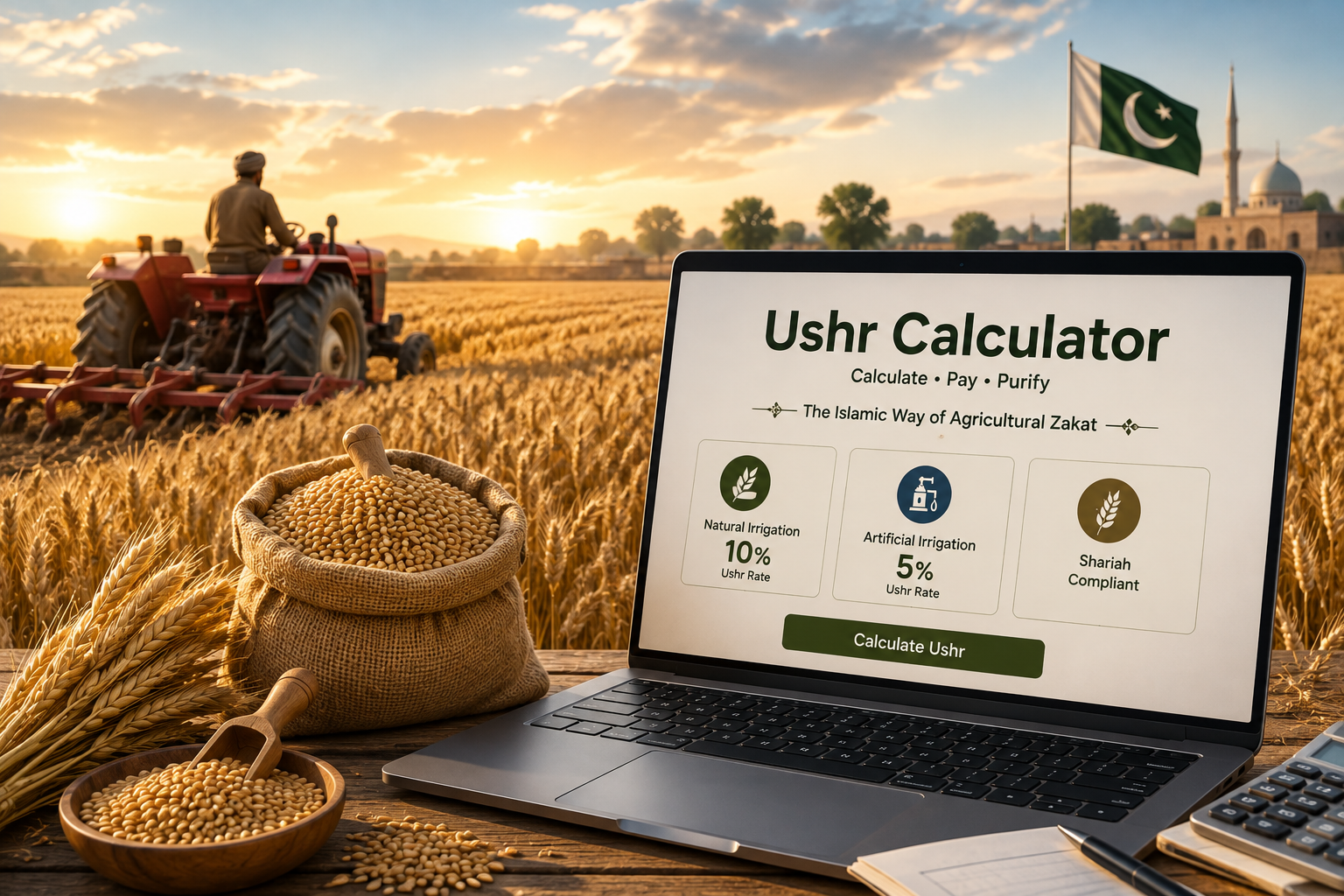
Ushr Calculator: Calculate Ushr on Agricultural Produce in Pakistan
Use the Ushr Calculator above to estimate Ushr on agricultural crops and farm produce using the applicable irrigation rate and calculation method. Whether you are calculating Ushr on wheat, rice, dates, grain, or other qualifying agricultural produce, the key factors are the type of produce, the method of irrigation, the amount harvested, and the Islamic legal method you follow.
This guide explains how Ushr is calculated, the difference between the 10% and 5% rates, how the five-Awsuq threshold is treated, the Hanafi position, how farming expenses affect the calculation, and how Pakistani farmers can work with familiar units such as kilograms and Maund/Man.
What Is Ushr in Islam?
Ushr is the agricultural Zakat associated with qualifying crops and produce. Unlike ordinary Zakat on wealth, agricultural Zakat is connected to the harvest rather than waiting for a complete lunar year. The amount due depends particularly on how the land was irrigated.
The word “Ushr” literally refers to one-tenth, which corresponds to the 10% rate applied to naturally irrigated produce. When irrigation requires human effort or mechanical cost, the applicable amount is half of Ushr, commonly called Nisf Ushr, or 5%.
This distinction comes directly from the Prophetic teaching reported in Sahih al-Bukhari 1483: produce watered by rain or natural water channels is subject to one-tenth, while produce watered through effort such as drawing water is subject to one-twentieth.
Ushr Calculation Formula
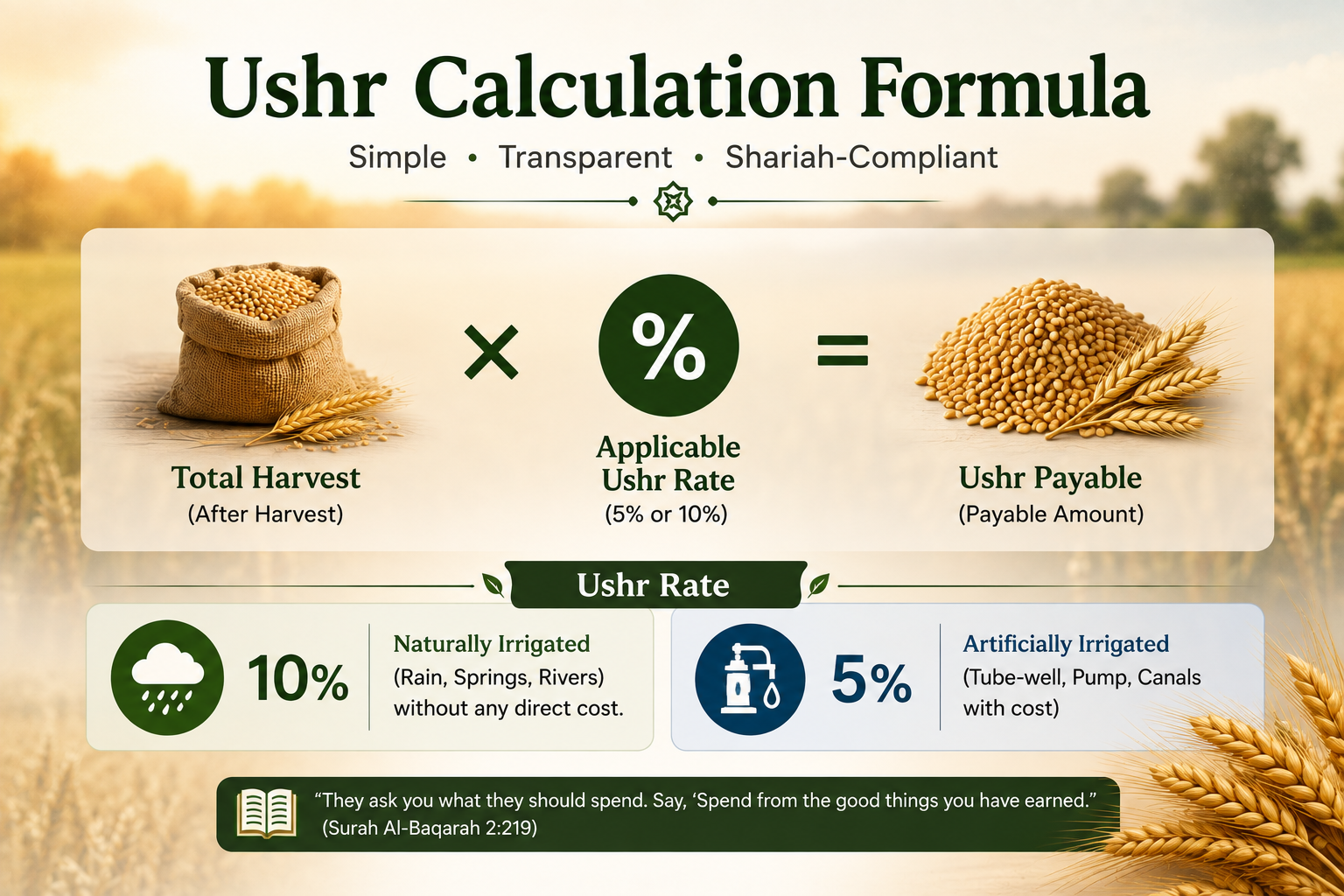
The basic Ushr calculation formula is straightforward once the correct rate has been identified.
If you are calculating by monetary value, the same percentage can be applied to the qualifying produce value where payment by value is valid under the method being followed.
10% Ushr Formula
For qualifying produce irrigated naturally:
For example, if 2,000 kg of qualifying wheat is naturally irrigated:
The calculated Ushr is 200 kg of produce.
5% Ushr Formula
For qualifying produce irrigated through a cost-based human or mechanical method:
If the same 2,000 kg harvest was irrigated through a cost-based pumping system:
The calculated Ushr is 100 kg of produce.
What Is the Rate of Ushr on Naturally and Artificially Irrigated Land?
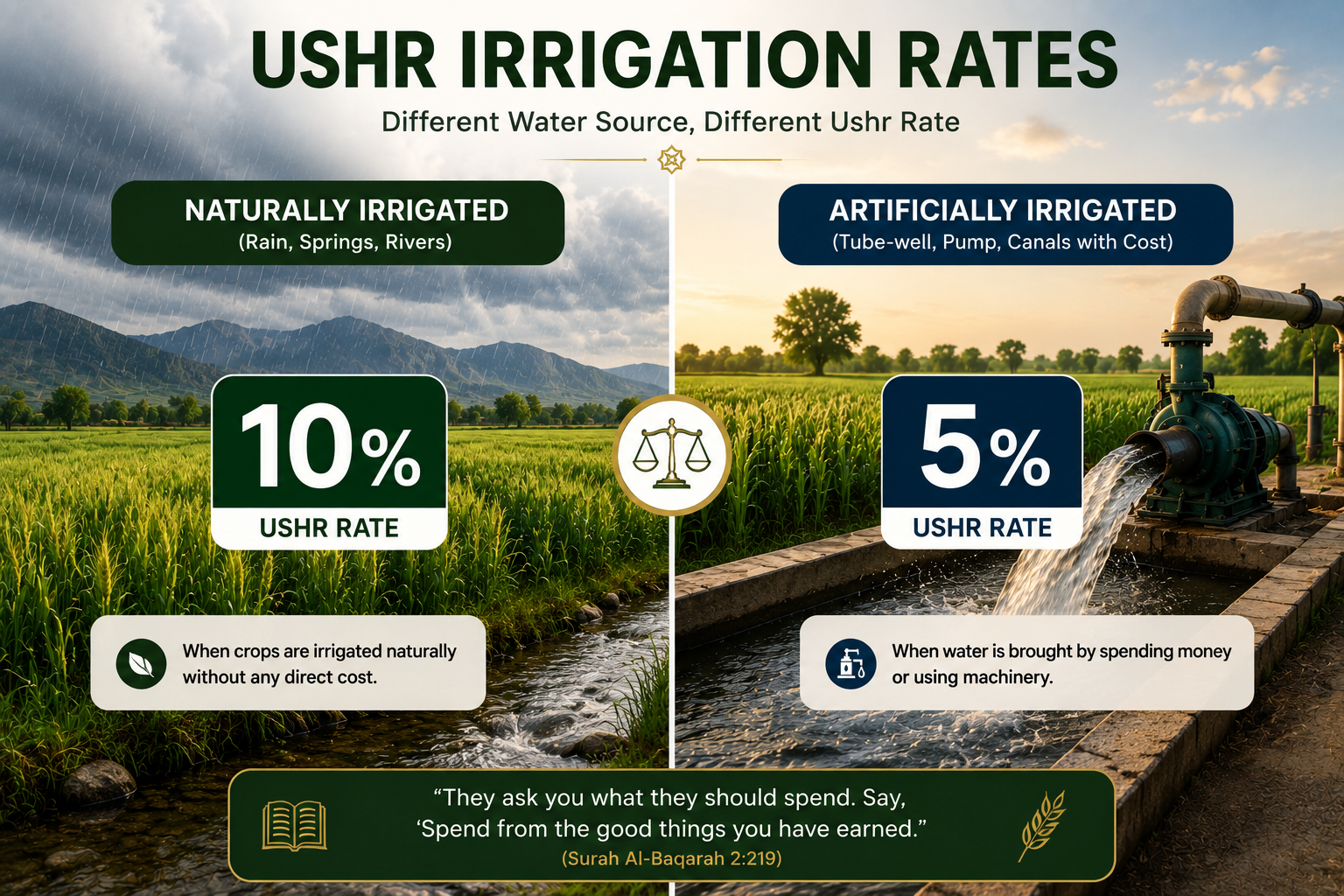
The rate of Ushr on artificially irrigated land and naturally irrigated land is one of the most important parts of an accurate calculation. The rate is based on the irrigation method, not simply the name of the crop.
| Irrigation Method | Typical Rate | Simple Explanation |
|---|---|---|
| Rain / natural water | 10% | Water reaches the crop naturally without cost-based mechanical lifting. |
| Cost-based human or mechanical irrigation | 5% | Watering requires effort or machinery, such as pumping or drawing water. |
| Mixed irrigation | Depends on the applicable method | Under the Hanafi guidance cited below, the method that predominates is considered. |
Rain-Fed and Naturally Irrigated Crops — 10%
If the crop is watered by rainfall or comparable natural irrigation without the relevant watering cost, the standard rate is one-tenth (10%). This is the full Ushr rate.
Artificial or Cost-Based Irrigation — 5%
If water must be supplied through human or mechanical effort involving irrigation cost, the standard rate is one-twentieth (5%). This is commonly described as Nisf Ushr.
What About Canal Irrigation?
Do not assume that the word canal automatically means 5%. The underlying distinction in the Prophetic report is between natural watering and watering involving the relevant effort/cost. A farmer should classify the actual irrigation arrangement rather than choosing a rate only because a particular water source is called a canal.
What If Both Natural and Artificial Irrigation Are Used?
Mixed irrigation requires more care. In the Hanafi guidance published by SeekersGuidance, when crops are irrigated both naturally and by human watering, the method that predominates is considered. If your irrigation is genuinely balanced and it is unclear which ruling applies, obtain guidance from a qualified scholar instead of guessing a percentage.
What Is the Nisab of Ushr?
This is where an accurate Ushr calculator must avoid presenting a single jurisprudential view as though there were no scholarly difference.
Five Awsuq Method
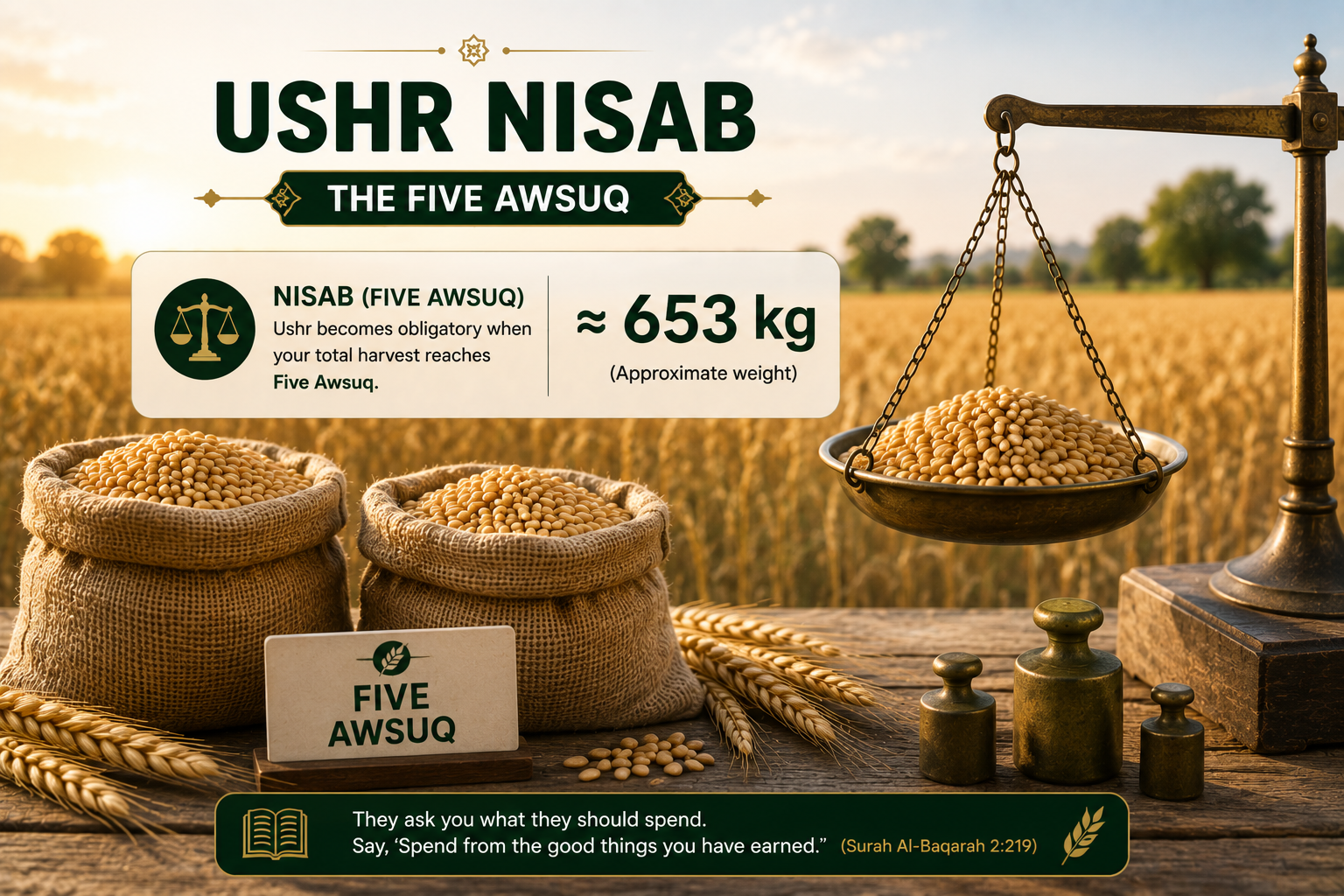
A widely followed view applies a minimum threshold of five Awsuq. Five Awsuq equals 300 Sa‘. Converting this classical volume measure into a modern kilogram figure is approximate and varies according to the commodity and conversion method.
Published contemporary estimates include approximately 612 kg, while some scholars use approximately 653 kg. This is why a modern calculator should label a kilogram conversion as an approximation rather than pretending that every classical measure has one exact universal metric weight.
The NexusEase calculator uses approximately 653 kg when the user selects its “5 Awsuq Method,” while clearly treating the figure as an approximation.
Hanafi Method
The Hanafi treatment differs on the minimum agricultural threshold. The Hanafi guidance from SeekersGuidance states that agricultural Zakat becomes due when the produce ripens irrespective of the amount of produce. For that reason, the calculator does not impose the five-Awsuq minimum when the Hanafi method is selected.
Ushr Calculator Pakistan: Kg, Maund and PKR
For users looking for an Ushr calculator Pakistan, a practical problem with many international calculators is that they assume every farmer works only in pounds or kilograms. Pakistani agricultural markets commonly use Maund (Man) alongside kilograms.
For calculator conversion purposes, NexusEase uses:
This makes it much easier to calculate a harvest recorded in local market units. The calculator can also display monetary calculations in PKR. Selecting PKR changes the calculation currency label; it does not pretend to perform a live foreign-exchange conversion.
How to Calculate Ushr in Maund
Suppose a farmer has 50 Maund of wheat.
If the qualifying crop is naturally irrigated and a 10% rate applies:
If cost-based mechanical irrigation is used and a 5% rate applies:
These examples assume that the crop itself is subject to agricultural Zakat under the jurisprudential method being followed and, where a minimum threshold applies, that the relevant Nisab has been met.
Ushr on Wheat: Simple Pakistan Examples
Ushr on wheat is a particularly useful example because wheat harvests in Pakistan may be recorded in kilograms or Maund.
Example 1: 100 Maund Wheat With Natural Irrigation
100 Maund equals 4,000 kg using the 40 kg conversion.
That equals approximately 400 kg of wheat.
Example 2: 100 Maund Wheat With Cost-Based Pump Irrigation
That equals approximately 200 kg of wheat.
Example 3: Calculating by Crop Value
Suppose qualifying produce has a total market value of PKR 500,000. If the applicable rate is 10%:
At a 5% rate:
Whether payment may be made in cash value rather than the produce itself depends on the jurisprudential method followed. The Hanafi guidance cited in this article permits calculating the market value and paying the equivalent in cash.

Can Farming Expenses Be Deducted Before Calculating Ushr?
A common question is whether expenses such as fertilizer, diesel, labour, machinery, land costs, or taxes should first be deducted from the harvest value and then Ushr calculated only on the remaining profit.
Under the Hanafi guidance reviewed for this calculator, Ushr is paid on the total produce and taxes and farming expenses are not deducted first. This is why the calculator may allow expenses to be recorded for reference but does not subtract them from the Ushr calculation base.
This distinction is important because irrigation cost is already relevant to determining whether the 10% or 5% irrigation rate applies; it should not automatically become a second deduction from the calculation base.
When Is Ushr Paid?
Agricultural Zakat is tied to the harvest rather than the normal one-lunar-year holding period associated with many other forms of Zakat. The Hanafi source reviewed for this guide describes the obligation in connection with the produce becoming ripe, rather than waiting for a complete year.
This is one reason an Ushr calculator online should be designed around harvest details—produce, irrigation, quantity, and applicable method—rather than simply copying a conventional 2.5% annual Zakat calculator.
Ushr vs Zakat: What Is the Difference?
| Feature | Ushr / Agricultural Zakat | Common Wealth Zakat |
|---|---|---|
| Main subject | Qualifying agricultural produce | Qualifying wealth/assets |
| Common rate | 5% or 10%, depending on irrigation | Often 2.5% for qualifying monetary wealth |
| Timing | Connected to harvest | Typically after the applicable lunar-year conditions are met |
| Key calculation factor | Irrigation method and applicable crop rules | Nisab, qualifying assets and other Zakat rules |
So a standard Zakat calculator should not simply be used as an Ushr calculator. Agricultural produce has its own rules and rates.
How to Use the Ushr Calculator Online
The calculator above is designed to make the calculation easier without hiding the important choices from the user.
- Select the calculation method. Choose Hanafi or the five-Awsuq method according to the jurisprudential method you follow.
- Select your currency. Pakistani users can choose PKR. Currency selection labels your calculation; it is not an exchange-rate converter.
- Select the irrigation type. Choose natural/rain-fed, cost-based pump irrigation, or mixed irrigation.
- Choose By Value, By Weight, or Multiple Crops.
- Enter the harvest details. Weight calculations support kg, Maund/Man, pounds and tonnes.
- Check the result breakdown. The tool shows the gross value, Nisab status where applicable, rate used, and estimated Ushr due.
By Value
Use this option when you know the total value of the qualifying crop. If you select the five-Awsuq method, the calculator also asks for harvest weight because a monetary value alone cannot establish a weight/volume-based Nisab.
By Weight
Enter the harvested quantity, select kg, Maund, pounds or tonnes, and enter the price per selected unit. This lets the calculator show both the produce-based calculation and its monetary value.
Multiple Crops
Use the multiple-crops option when you have more than one harvest to calculate. Each crop should be entered separately so its value, quantity and irrigation method can be considered instead of blindly applying one percentage to an unrelated combined total.
Why an Online Ushr Calculator Is Useful
Manual calculations are simple in a basic case, but mistakes become easier when a farmer needs to convert Maund into kilograms, distinguish 5% from 10%, check a threshold, calculate several crops, or compare produce and monetary values.
A well-designed Ushr calculator online does not replace Islamic scholarship. Its job is to apply the inputs and method selected by the user consistently, show the calculation transparently, and flag cases that need further guidance.
Common Ushr Calculation Mistakes
- Using 2.5% automatically: Agricultural Zakat should not be treated like ordinary annual wealth Zakat.
- Using 10% for every farm: Cost-based mechanical irrigation generally changes the rate to 5%.
- Using 5% for every canal: The actual irrigation arrangement and cost/effort distinction matters.
- Deducting every farming expense first: The Hanafi guidance cited here calculates Ushr on total produce without first deducting taxes and expenses.
- Applying 653 kg as an undisputed universal rule: The Hanafi method differs on the minimum threshold, while modern conversions of five Awsuq also vary.
- Confusing crop value with crop weight: A monetary amount alone cannot prove a weight-based five-Awsuq threshold.
- Guessing in a complicated mixed-irrigation case: Where the applicable method is unclear, ask a qualified scholar.
Frequently Asked Questions About Ushr
How is Ushr calculated?
Identify the qualifying agricultural produce and applicable jurisprudential method, determine the irrigation type, then apply the appropriate rate. Natural irrigation generally uses 10%, while cost-based human or mechanical irrigation generally uses 5%.
What is the percentage of Ushr?
The two standard irrigation-based rates are 10% for naturally watered produce and 5% for produce watered through relevant human/mechanical effort or cost.
What is the rate of Ushr on artificially irrigated land?
Where irrigation requires cost-based human or mechanical watering, the standard rate is 5%, or one-twentieth of the qualifying produce.
What is the rate of Ushr on rain-fed land?
Qualifying produce watered naturally by rain or comparable natural sources is generally subject to 10%, or one-tenth.
What is the Nisab of Ushr on wheat?
Under the five-Awsuq view, the threshold is five Awsuq (300 Sa‘). Modern kilogram conversions vary; published estimates include roughly 612 kg and 653 kg. The Hanafi position cited in this guide does not impose that minimum amount in the same way.
How much Ushr is due on 100 Maund of wheat?
Using 1 Maund = 40 kg, 100 Maund equals 4,000 kg. If the applicable rate is 10%, the calculation is 10 Maund. At 5%, it is 5 Maund, assuming the wheat is qualifying produce and the other conditions of the method you follow are satisfied.
Can I calculate Ushr in PKR?
Yes. The calculator can express the estimated value in PKR. In the Hanafi guidance cited here, the market value of the amount due may be calculated and its equivalent paid in cash.
Can farming expenses be deducted before Ushr?
The Hanafi source used for this guide states that taxes and farming expenses are not deducted before calculating Ushr; it is paid on the total produce.
Is there an Ushr calculator Urdu option?
The current calculator is designed with simple labels and Pakistan-friendly units. An Urdu interface can also be provided separately without changing the underlying calculation principles.
Is Ushr due every year?
Ushr is connected to agricultural produce and harvest rather than simply waiting for the normal annual Zakat cycle. The exact conditions should be applied according to the jurisprudential method being followed.
Does every crop have exactly the same Ushr ruling?
No. Schools of Islamic law differ regarding the categories of agricultural produce on which Zakat is due. The calculator can perform the arithmetic, but users should confirm that their particular crop is subject to Ushr under the method they follow.
Can an Ushr calculator replace a Mufti or Islamic scholar?
No. An online calculator is useful for arithmetic and standard cases, but questions involving crop eligibility, unusual irrigation, ownership arrangements, tenancy, disputed thresholds, or other fiqh details should be referred to a qualified scholar.
Final Thoughts
The purpose of an Ushr Calculator is to turn a potentially confusing agricultural calculation into a clear process: choose the method you follow, identify the irrigation system, enter the harvest quantity or value, and review the calculation transparently.
For farmers in Pakistan, support for PKR, kilograms and Maund/Man makes the process more practical. More importantly, the calculator distinguishes between the 5% and 10% irrigation rates and does not silently treat one Nisab opinion as universal.
Use the calculator above for an estimate, review the calculation breakdown, and consult a qualified Islamic scholar whenever your crop, irrigation arrangement, ownership structure, or jurisprudential situation requires an individual ruling.
Sources and Methodology
This guide uses the irrigation-rate principle reported in Sahih al-Bukhari 1483 and Hanafi guidance published by SeekersGuidance for the treatment of agricultural produce, expenses, mixed irrigation and the Hanafi threshold position. For the five-Awsuq approach and modern approximate kilogram conversions, the article notes published estimates rather than presenting one conversion as mathematically exact.
- Sahih al-Bukhari 1483 — agricultural irrigation rates
- SeekersGuidance — Zakat on Agricultural Produce in the Hanafi School
- SeekersGuidance — Expenses and Ushr
- IslamQA — Five Awsuq and approximate modern weight
Editorial note: This page provides a calculation aid and educational overview, not an individual fatwa. Islamic legal rulings can vary by school and circumstances.